Plication
A shortening technique may be suitable when length is sufficient, erections are preserved and the deformity is less complex.
06 / Peyronie's disease · curvature · reconstruction
The goal of Peyronie's disease treatment is to restore function and the ability to have sex, rather than to create a geometrically perfect result. Management depends on the disease stage, the type of deformity, penile length and erection quality.
This material was prepared by a doctor using Russian clinical guidelines and EAU guidance. It does not establish a diagnosis, prescribe treatment or replace an in-person consultation. The choice of method depends on investigations, coexisting conditions and individual risks. A surgical outcome cannot be guaranteed in advance.
01 / Indications
02 / Decision
The assessment covers disease duration, pain, changes in shape, length, the degree and direction of curvature, erectile function and the patient's expectations. The deformity must be documented objectively, using safely taken home photographs or a medical test.
A shortening technique may be suitable when length is sufficient, erections are preserved and the deformity is less complex.
Incision or partial incision of the tunica albuginea with grafting is discussed for severe or complex curvature with preserved erections.
In severe erectile dysfunction, an implant can provide rigidity while also allowing the deformity to be corrected.
03 / A separate question
First, the type and duration of the problem, ejaculatory control, erectile function and inflammatory or other possible causes are clarified. Treatment usually centres on explanation, behavioural options and medication when indicated.
Selective dorsal neurectomy should not be presented as a standard service: current guidelines point to insufficient evidence on long-term safety.
04 / Preparation
05 / Surgery
Plication shortens the longer side. Grafting lengthens the shorter side and covers the defect with graft material. In severe erectile dysfunction, an implant both provides rigidity and allows correction of the deformity.
The method is chosen after discussing the expected straightening, change in length, and risks to erections and sensation. Neither perfect straightness nor preservation of the original length can be guaranteed.
Clinical practice
The photographs show reconstructive surgery in clinical practice. The method is chosen after assessing the deformity, erectile function, expectations and alternatives.
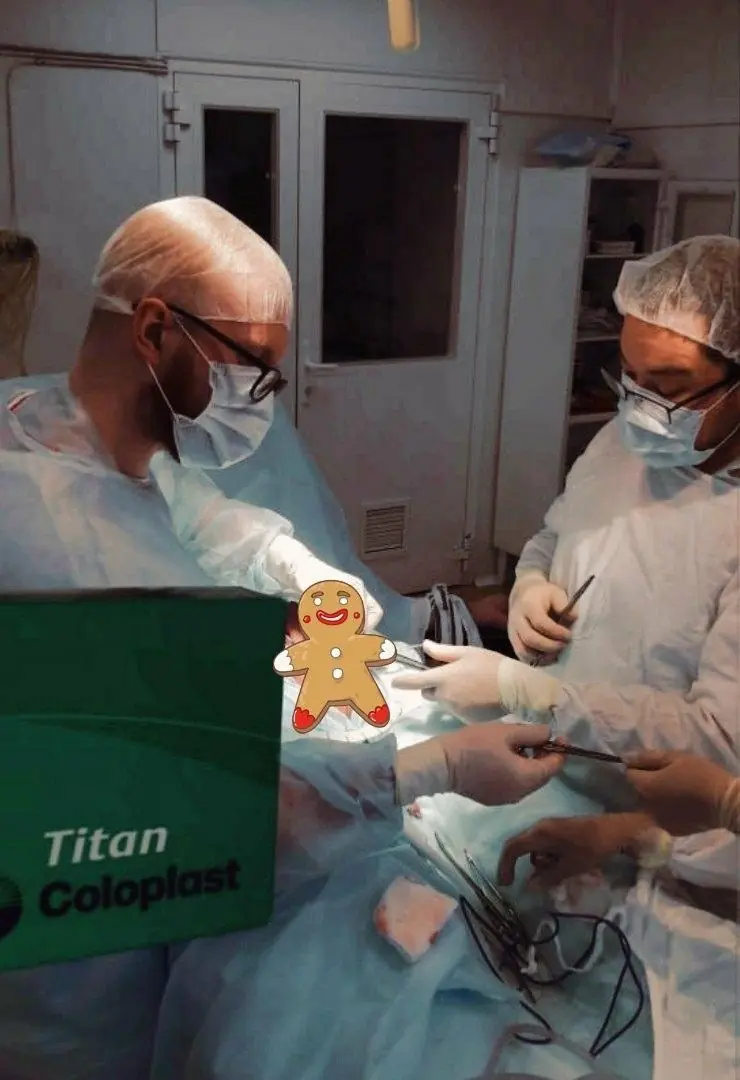
Insertion of a three-piece penile prosthesis as one option when deformity is combined with severe erectile dysfunction
06 / After surgery
Swelling, bruising and soreness are expected. Temporary changes in sensation are possible. When you can return to work, physical activity and sexual activity depends on the operation chosen and the findings at follow-up.
07 / Risks
08 / Urgent care
After surgery: a rapidly enlarging haematoma, active bleeding, high fever, purulent discharge, wound separation or urinary retention.
An injury to an erect penis with a cracking sound, sudden severe pain, bruising and abrupt loss of erection requires emergency assessment.
Patient questions
When pain and the shape of the deformity have stopped changing over an observation period. The exact duration and signs of stability are established at an in-person consultation.
No. Different methods affect length, erections and sensation differently. These trade-offs are discussed before choosing an operation.
No. It can be useful in erectile dysfunction and when planning complex reconstruction, but the extent of the assessment is determined individually.
Verifiable evidence
This page explains general guidance in plain language. Decisions for an individual patient are made after an in-person assessment and cannot be reduced to a single guideline recommendation.
In-person assessment and a clear plan